


Most of the definitions of semiseparable matrices are made by using generators, for example the papers [5,15,32,42]. After given the definition we will investigate the properties of this class of semiseparable matrices in correspondence with the properties of Corollary 2.1
 is called a semiseparable matrix of semiseparability rank
 if
there exist two matrices
 and
 both of rank , such that

 and
 denote respectively the strictly upper triangular
part of the matrix and the lower triangular part of the
matrix . Suppose
 , because and are now two rank one matrices,
they can both be written as the outer product of two vectors, respectively
 and
 for and
 and
 for . These vectors are also
called the generators of the semiseparable matrix .
 are defined now. This definition is already much
stronger than just defining semiseparable matrices as the inverses of
symmetric tridiagonals. We can reconstruct the matrices by keeping
 information. For example a symmetric semiseparable matrix of
rank looks like:
 |
In the following part when we speak about semiseparable matrices, we
mean symmetric semiseparable matrices of semiseparability rank . We will also denote semiseparable matrices satisfying
Definition 3 with  , this means a semiseparable
matrix representable with two generators and . A semiseparable plus diagonal matrix is defined as the sum of
a semiseparable matrix and a diagonal one.
The following example is included, to illustrate some common misunderstandings about semiseparable matrices. In several papers there are statements which are not completely true.
 |
and . Matrix  is its
own inverse, and one cannot represent this matrix with two generators
and . When we expand this class to the class of semiseparable
plus diagonal matrices, we can represent the matrix in this
way, but this is not the case for all the inverses of tridiagonal
matrices.
For example consider the following matrix , which is a block combination of the matrix from above:
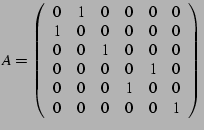 |
and nor by two generators
 and a diagonal.
The following example deals with the numerical instability of the representation with generators. The reason is the non-closedness of the class of semiseparable matrices as defined in Definition 3 for the pointwise limit.
 matrix is given with the following eigenvalues:
 . Constructing a semiseparable matrix from it (the procedure,
how to do so is explained in paper [41]) generates the
following matrix (Using
 decimal digits of precision in
Matlab5.):
and gives us the following vectors:
 |
 |
with the given generators
and gives huge errors in the matrix (up to  ). This
means that this representation looses almost
 decimal digits. The digit
loss in this example is unacceptable. This problem can however be
explained rather easily, and it is inherent to the representation
connected with the definition.
Because the diagonal matrices do not belong to the class of matrices
representable by the generators and , the representation of the
matrix above can never be very well. Very large and very small numbers can be seen in the vectors
and to try to compensate the fact that the matrix is almost block
diagonal.
Both examples immediately reveal problems of the representation and the definition of semiseparable matrices. First of all, not all inverses of tridiagonal matrices can be represented, and also diagonal matrices cannot be found in the class of matrices of Definition 3. Therefore an extension of this definition is needed.
