next up previous
Next: Numerical examples Up: On computing the eigenvectors Previous: "Iterative refinement" for the


Numerical multiple eigenvalues

One of the most used methods to compute the eigenvectors of a tridiagonal matrix is the inverse iterations method. The blemish in this approach is that the computed eigenvectors may not be numerically orthogonal if clusters are present in the spectrum. To enforce orthogonality the Gram-Schmidt procedure is used, requiring $ O(n^3)$ operations in the worst case. At first sight, also the proposed method of section 3 suffers from the loss of orthogonality in the presence of clusters in the spectrum. In this section we show that the latter drawback is easily overcome by the proposed method. Suppose the eigenvalues are ordered such that,
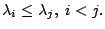
$\displaystyle \lambda_i \le \lambda_j, \; i < j. $

Two eigenvalues do not belong to the same cluster, if the following condition is satisfied [2].

Condition 4.1   The eigenvalue $ \lambda$ should have an adequate separation from the rest of the spectrum,i.e.,

   gap$\displaystyle (\lambda) := \min_{\lambda\ne \mu }
{\vert\lambda - \mu\vert } \ge {\tt tolg}, \;
\lambda \ne 0,
$

where $ \mu $ ranges over the other eigenvalues of $ T_n^{(0)}. $

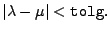
A good choice of $ {\tt tolg}$ is $ 10^{-3} \Vert T_n^{(0)} \Vert _{\infty}$, [2], [15, p. 322]. Therefore, we will say that two eigenvalues $ \lambda$ and $ \mu $ of $ T_n^{(0)} $ belong to the same cluster if

$\displaystyle \vert\lambda - \mu\vert < {\tt tolg}.
$

Without loss of generality, we suppose that a cluster of $ 2 $ eigenvalues is present in the spectrum, i.e. , $ \lambda_i \approx \lambda_{i+1}, \; 1 \le i <n. $

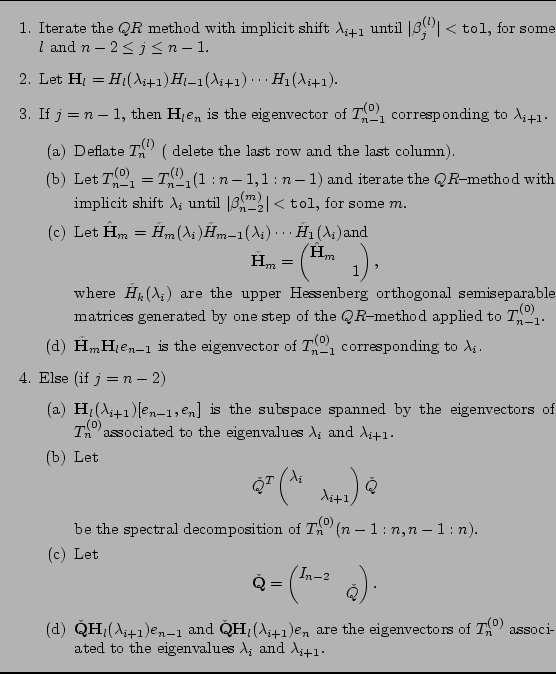
The algorithm to compute the eigenvectors corresponding to the eigenvalues belonging to the cluster is depicted in Fig. 2. The algorithm can be easily extended to a cluster of larger size.

Figure 2: Algorithm for computing the eigenvectors corresponding to a cluster consisting of $ \{ \lambda _{i}, \lambda _{i+1} \} $.
\begin{figure}\begin{center}
\hrule\hrule\vskip .2cm
\begin{enumerate}
\item Ite...
... $\end{enumerate}\end{enumerate}\vskip .2cm
\hrule\hrule\end{center}\end{figure}

Remark 4.1   If the size of the cluster is $ k,$ approximately $ O(k^2 n)$ floating point operations are needed to compute the eigenvectors. In many cases, however, more than one entry in the subdiagonal of the tridiagonal matrix $ T_n^{(l)} $ is tiny. Therefore, more than one row and column can be deflated from the matrix reducing considerably the computational complexity (see the numerical examples).


next up previous
Next: Numerical examples Up: On computing the eigenvectors Previous: "Iterative refinement" for the
Raf Vandebril 2004-10-08