Homepage of Raf Vandebril
| Whereabouts | |
| Papers | |
| Books | |
| Student info | |
| Research | |
| Research < 09 | |
| Pubs < 09 | |
| Books | |
| Papers/Reports | |
| Talks (Int.) | |
| Talks (Nat.) | |
| Posters | |
| Ph.D. | |
| Lic. Thesis | |
| Software | |
| PHP-software | |
| Links | |
Books
- Core-Chasing Algorithms of the Eigenvalue Problem
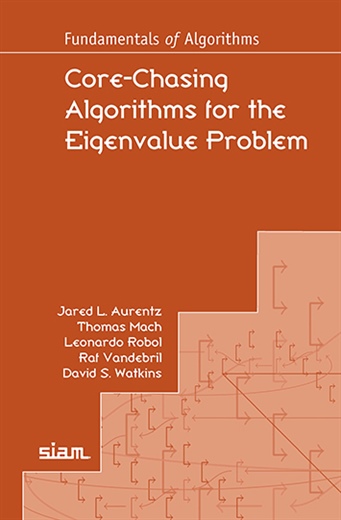
Jared L. Aurentz, Thomas Mach, Leonardo Robol, Raf Vandebril, and David S. Watkins
Core-Chasing Algorithms for the Eigenvalue Problem, ix+149 pages.
SIAM: Society for Industrial and Applied Mathematics., 2018. (ISBN: -13: 978-0- 8018-9052-9)
See: SIAM Bookstore.
Description: Eigenvalue computations are ubiquitous in science and engineering. John Francis's implicitly shifted QR algorithm has been the method of choice for small to medium sized eigenvalue problems since its invention in 1959. This book presents a new view of this classical algorithm. While Francis's original procedure chases bulges, the new version chases core transformations, which allows the development of fast algorithms for eigenvalue problems with a variety of special structures. This also leads to a fast and backward stable algorithm for computing the roots of a polynomial by solving the companion matrix eigenvalue problem. The authors received a SIAM Outstanding Paper prize for this work. - Matrix Computations & Semiseparable Matrices II: Eigenvalue and Singular Value Methods

Vandebril R., Van Barel M. and Mastronardi N.,
Matrix Computations & Semiseparable Matrices II: Eigenvalue and Singular Value Methods, 520 pages.
Johns Hopkins University Press., 2008. (ISBN-13: 978-0- 8018-9052-9)
See: Matrix Computations & Semiseparable Matrices II
Description: The general properties and mathematical structures of semiseparable matrices were presented in volume 1 of Matrix Computations and Semiseparable Matrices. In volume 2, Raf Vandebril, Marc Van Barel, and Nicola Mastronardi discuss the theory of structured eigenvalue and singular value computations for semiseparable matrices. These matrices have hidden properties that allow the development of efficient methods and algorithms to accurately compute the matrix eigenvalues. This thorough analysis of semiseparable matrices explains their theoretical underpinnings and contains a wealth of information on implementing them in practice. Many of the routines featured are coded in Matlab and can be downloaded from the Web for further exploration. - Matrix Computations & Semiseparable Matrices I: Linear Systems

Vandebril R., Van Barel M. and Mastronardi N.,
Matrix Computations & Semiseparable Matrices I: Linear Systems, 570 pages.
Johns Hopkins University Press, 2007. (ISBN-13: 978-0-8018-8714-7)
See: Matrix Computations & Semiseparable Matrices I
Description: Few mathematical structures are used and applied as frequently as matrices. Applied mathematicians, engineers, and physicists rely heavily on matrices when number-crunching. In recent years several new classes of matrices have been discovered and their structure exploited to design fast and accurate algorithms. In this new reference work, Raf Vandebril, Marc Van Barel, and Nicola Mastronardi present the first comprehensive overview of the mathematical and numerical properties of the family's newest member: semiseparable matrices. The text is divided into three parts. The first provides some historical background and introduces concepts and definitions concerning structured rank matrices. The second offers some traditional methods for solving systems of equations involving the basic subclasses of these matrices. The third section discusses structured rank matrices in a broader context, presents algorithms for solving higher-order structured rank matrices, and examines hybrid variants such as block quasiseparable matrices. An accessible case study clearly demonstrates the general topic of each new concept discussed. Many of the routines featured are implemented in Matlab and can be downloaded from the Web for further exploration.
Remark: Appeared in the list Bestsellers in Mathematics.
Errata in Matrix Computations Volume I
The following errors/improvements were reported to us by readers, who I'd like to thank for there careful reading.- In several instances I wrote ``of rank 1''. In a certain sense, this is not meant strict, perhaps it would have been better to write of rank at most 1.
- Definitions 1.1,1.3, and 1.5 could be improved when changing to ``of rank at most 1''.
- In the proof of Proposition 1.19, the sentence "such that the left matrix is of rank 1" could say "such that the left matrix is of rank at most 1".
- In page 23, third line from the bottom, it could say "are of rank at most 1".
- Chapter 7, 7.2.3, Page 271: The algorithm writes p_n=..../-b_{n-1}p_{-1}... , it should be p_n=..../-b_{n-1}p_{n-1}...
Software
Follow this link.| Statistics - About this site Generate time: 0.52906 seconds Page last changed on: (October 12 2020 14:02:36 ) | © Raf Vandebril Mail raf.vandebril Disclaimer |