


Next: Symmetric tridiagonal matrices
Up: Semiseparable matrices and their
Previous: Semiseparable matrices and their
Originally, semiseparable matrices were defined as the inverses of
unreducible tridiagonal matrices, see for instance
[1,36]. Later on they were also defined as the inverses of unreducible
band matrices [21]. Note that these early definitions
immediately exclude the possibility of having singular semiseparable
matrices. In the book [21] semiseparable matrices got for the
first time a name, namely one-pair or single-pair matrices (depending
on the translation; the book was originally written in Russian). In fact
these one-pair matrices are a special sort of semiseparable matrices,
and they have strong connections with Jacobi
matrices, more commonly known as tridiagonal matrices. In this section
the two most important theorems of the book [21] will be
mentioned, and their proofs will be given in appendix A.
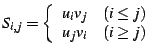
Originally the one-pair matrices were defined as:
Definition 1
A one-pair matrix
is a symmetric matrix

such that
 |
(1) |
where the elements

and

are chosen arbitrarily.
The main theorem in [21, Chapter II] states that the inverse
of an unreducible Jacobi matrix is a one-pair matrix.
Theorem 1.1
Suppose

is a symmetric tridiagonal matrix of size

:
 |
(2) |
with all the

different from zero. The inverse of
will be
a one-pair matrix.
PROOF:
See appendix A.

This theorem states that the inverse of an unreducible symmetric tridiagonal matrix is a so called
one-pair matrix, nothing is mentioned about general tridiagonal
matrices.
Also the inverse of the preceding theorem is true:
the inverse of an invertible one-pair matrix is a tridiagonal matrix, with nonzero
subdiagonal elements. The proof is given in appendix A.
Next: Symmetric tridiagonal matrices
Up: Semiseparable matrices and their
Previous: Semiseparable matrices and their
Raf Vandebril
2004-04-19